
Small Danish Hotels has worked purposefully on optimising its processes and systems, and achieved outstanding results – helped along by smart custom features in Yulsn Marketing Cloud.

11. april 2023
Too little time for far too many tasks was the main motive when Small Danish Hotels set a focused effort in motion to optimise processes and systems.
The work on optimising processes had begun shortly before the Covid lockdown in March 2020 – but the lockdown made it urgent and put speed into the process.
The lockdown meant there were suddenly no products to sell, and almost no staff at work to make emails for the roughly 170,000 guest club members.
Within a matter of days the first of 10 separate initiatives was executed:
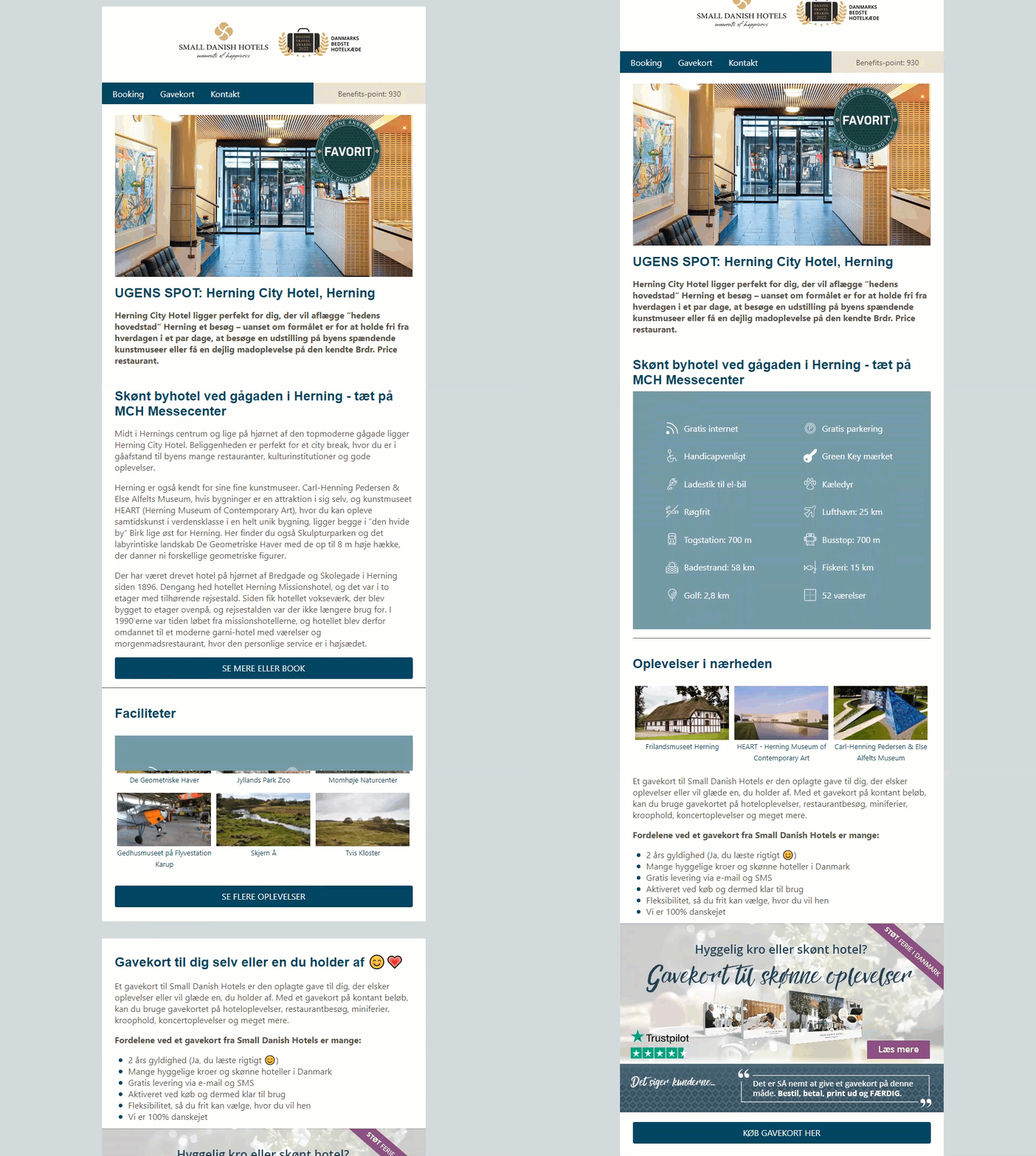
A new module was added to the newsletter template in Yulsn Marketing Cloud, making it possible for Small Danish Hotels to produce a finished email with a portrait of a chosen hotel simply by inserting the hotel's ID into the email.
During the period when the hotels were closed, the portrait could be combined with a prompt to buy gift cards and relevant information about the Covid situation.
That meant even the managing director could produce a weekly newsletter with a hotel portrait in a few minutes.
Building the solution in such a short time was possible because all the information about each hotel had already been transferred and was continuously synchronised between the website and Yulsn Marketing Cloud. And because Yulsn Marketing Cloud lets you build your own modules that use exactly the content you need.
See an example of the email here:
The next initiative was about reducing the considerable time spent finding relevant stays from the hotels and inserting the chosen stays into both campaign emails and automated emails.
The process was particularly heavy because all the content about the stays from each hotel was only available in the booking system, where the hotels themselves maintain the stays sold through Small Danish Hotels.
The booking system has no search function, so the marketing department needed help from the booking department, who could search code files from each hotel manually. Once the desired stays were found, they could be marked with a code in the booking system.
The marketing department could then create a hidden page on their website where, by entering the code from the booking system, they could display the information about the selected stays on the site.
After that they could start the work of building emails with the desired stays by hand.
It is the individual hotels that write the descriptive texts about each stay. That is a task not every hotel is equally good at.
So the marketing department often wrote new and better texts for the selected stays to be presented in the newsletters.
This process was very time-consuming, and it also meant specific stays could not be used in automated emails at all.
The new solution consisted of the following elements:
A new integration was set up between the booking system and Yulsn Marketing Cloud, so all stays from all hotels are transferred to Yulsn.
Yulsn processes the data and stores the cheapest variant of each stay in a separate table, combining that table with a short description of each hotel that the marketing department already maintains for the website.
A custom interface was built in Yulsn Marketing Cloud for searching and selecting stays, where selected stays can be grouped under a code via their IDs from the booking system.
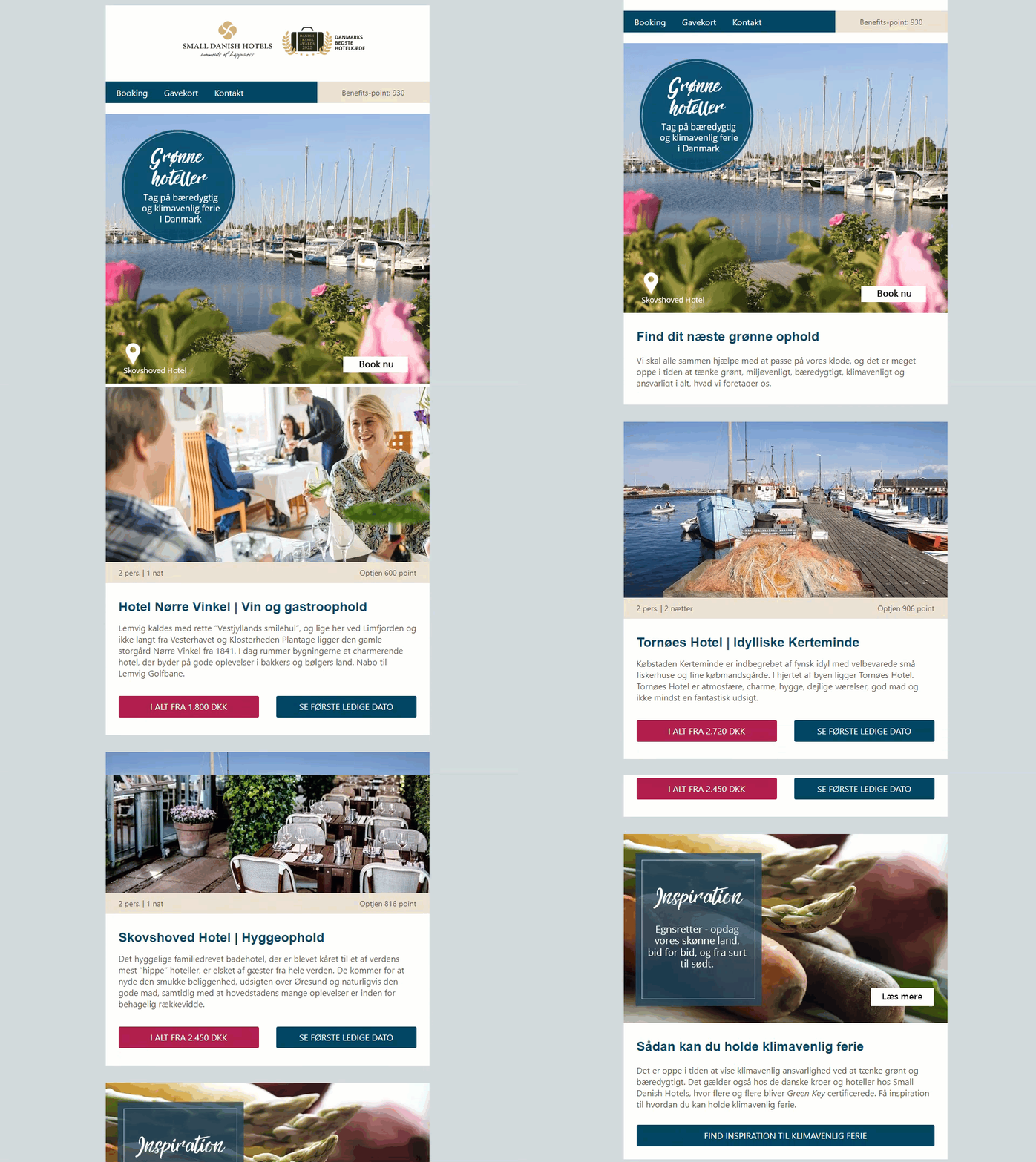
A new module was built for the email templates, so selected stays can be inserted into both campaign emails and automated trigger emails, and displayed the way they should be.
The new module uses the short text about the hotel instead of the text about the individual stay, so the marketing department does not have to write new text for each stay – and the stays can therefore be used in automated emails.
With the new solution it now takes the marketing department a few minutes to select and insert many stays into an email – and help from the booking department is no longer needed.
Here is an example of one of the emails using the new module:
With the new solution it is now very easy to build automated emails with selected stays, so the next initiative was an expanded welcome flow and a resale flow.
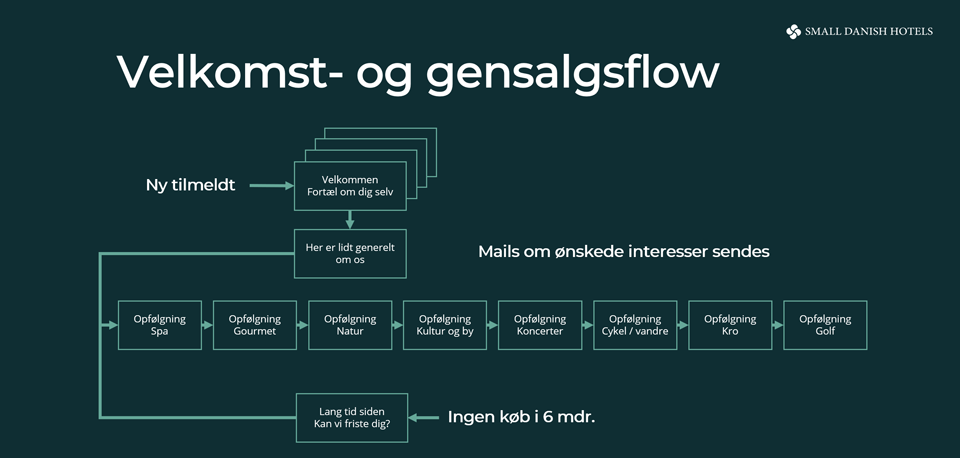
The welcome flow consists of the following emails:
The first welcome email is adapted depending on where the sign-up came from – so there are 10–12 variants. Every variant has a link to a very short questionnaire asking about interest in 8 different types of stay. Answering is rewarded with extra entries in the regular monthly prize draw.
The day after the first welcome email, welcome email no. 2 is sent, giving a short general introduction to Small Danish Hotels and the newsletters to come. It also carries a link to the questionnaire if it has not been answered.
Two days after email no. 2, the first of 8 theme-based emails is sent, with stays of the different types that could be chosen in the short questionnaire. Those who answered the questionnaire only get emails with the types of stay they selected. Those who did not answer get all 8 emails.
Exactly the same flow is also used for guest club members who have not stayed in the last 6 months.
They automatically receive an invitation to answer the questionnaire, and those who answer then automatically get the emails matching their interests.
With the large time savings on the ongoing setup of emails, there has been time to start a range of other automated emails – among them:
Segmented campaign emails every week.
Follow-up after a stay with automatic insertion of related hotels, maintained in a matrix table.
An expanded flow for abandoned online bookings.
A reactivation flow for those who do not open or click in emails.
Together the various initiatives have produced the following overall results over the 3 years from the start to this evaluation:
113% growth in the number of emails sent.
71% growth in website traffic from email.
44% growth in direct sales from email.
88% saving in the time spent on email marketing work (from around 125 hours to 15 hours a month).
Anne Mette Bach Jeppesen, who is responsible for email marketing at Small Danish Hotels, says this about the change:
It often used to take a whole day to make a single newsletter, and much of the work was done at the last minute because we depended on the booking department too. There was only time to make a few targeted emails! Now it takes 1 day a month to select the targeted stays to be used across all emails for a whole month. After that it takes about 1 day to make all the targeted campaign emails for a fortnight – and on top of that a lot of targeted emails run automatically using the same stays.
We are not dependent on the booking department, so when last-minute corrections come in, they are very easy and quick to make. That has meant my working day is less stressful, and I have more capacity for all my other tasks.
The means of achieving these strong results have been a structured and persistent effort, combined with the ability to adapt their email marketing system (Yulsn Marketing Cloud) to the processes they want.
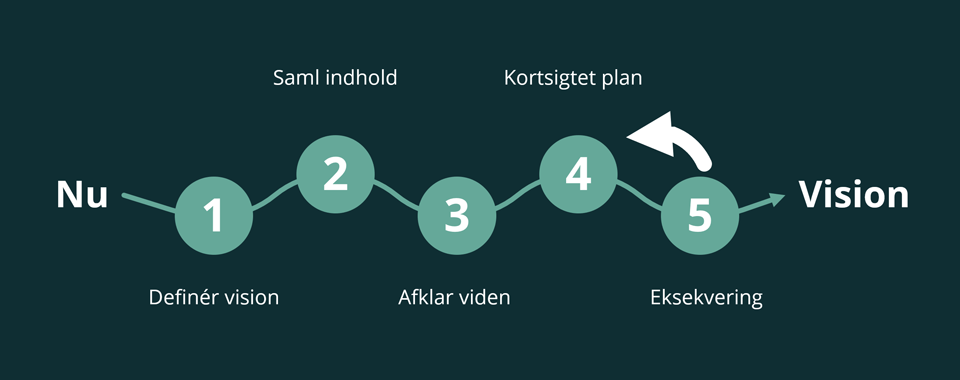
Small Danish Hotels has worked in a structured way from the following 5-step process:
They have defined a vision for their email marketing effort.
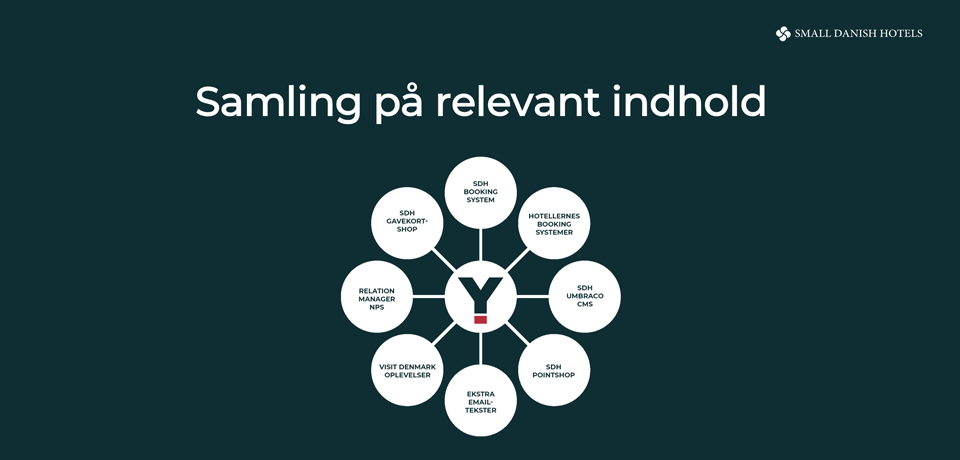
They have made sure to gather all relevant content in Yulsn Marketing Cloud so it can be used for communication.
They have clarified which information about their recipients they need in order to pursue their vision for the email marketing effort.
They have made a series of short-term plans, each of which has both created concrete results and brought them a step closer to their vision.
They have executed the short-term plans, evaluated after each effort, and then made a new short-term plan.
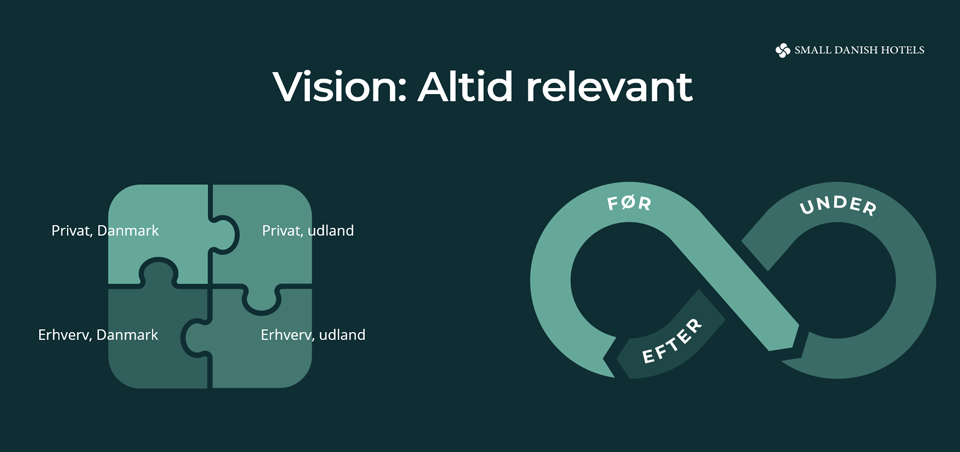
The vision Small Danish Hotels has defined for their email marketing effort is:
We will always deliver content that is as relevant as possible, to every audience, and at every stage of their customer journey.
Broadly speaking Small Danish Hotels has only 4 audiences: private and business guests, from Denmark and from abroad respectively.
But look closer at those groups and the differences in needs are large enough that there are a great many segments to deal with.
The same applies to the customer journey. Here Small Danish Hotels uses a simplified version of OMD's infinite customer journey, working with the phases "Before", "During" and "After" a stay.
Combine the 3 phases with the many segments and sub-segments, and delivering relevant content in every email to every recipient becomes a large and complex task.
That is precisely why it is a vision they work at getting closer and closer to, rather than a strategy with a specific target to be met.
An important precondition for succeeding in working towards a vision of always delivering relevant content is that the system sending the emails has access to – and the ability to use – all the content that is relevant to send to recipients.
At the great majority of companies, the content worth sending to recipients already exists in other systems – a website CMS or an e-commerce solution.
So there is very little text that has to be (or rather, ought to be) written specifically for emails.
Moreover, it is often the case that the text which is specific to emails can usefully be reused between different emails.
At Small Danish Hotels the bulk of the content for their emails comes from 8 different sources, all gathered in Yulsn Marketing Cloud.
With that as the starting point, they can continue their work of making new short-term plans for the email marketing effort. Execute their plans, evaluate, and then make new plans again.
The focused work on email marketing happens, of course, at the same time as the marketing department's work overall has to deliver its part in line with the company's overall strategy, goals and vision.