
Nemlig.com saves time and triples engagement and orders with their personalised, fully automated meal plan email.

10. juni 2025
If you want inspiration for dinner, would you rather have a plan tailored to what you like, or a generic one written by a food writer?
At Nemlig.com they offer both.
Every week their food writer puts together a suggestion of dishes for the week's meal plan. The plan can be found on their website and is sent to subscribers by email.
Alongside it they run a personalised, automated meal plan, set up as an AI experiment in 2023, which is now growing steadily until the automated plan is expected to replace the generic one.
The personal meal plan email increases engagement by up to 337%
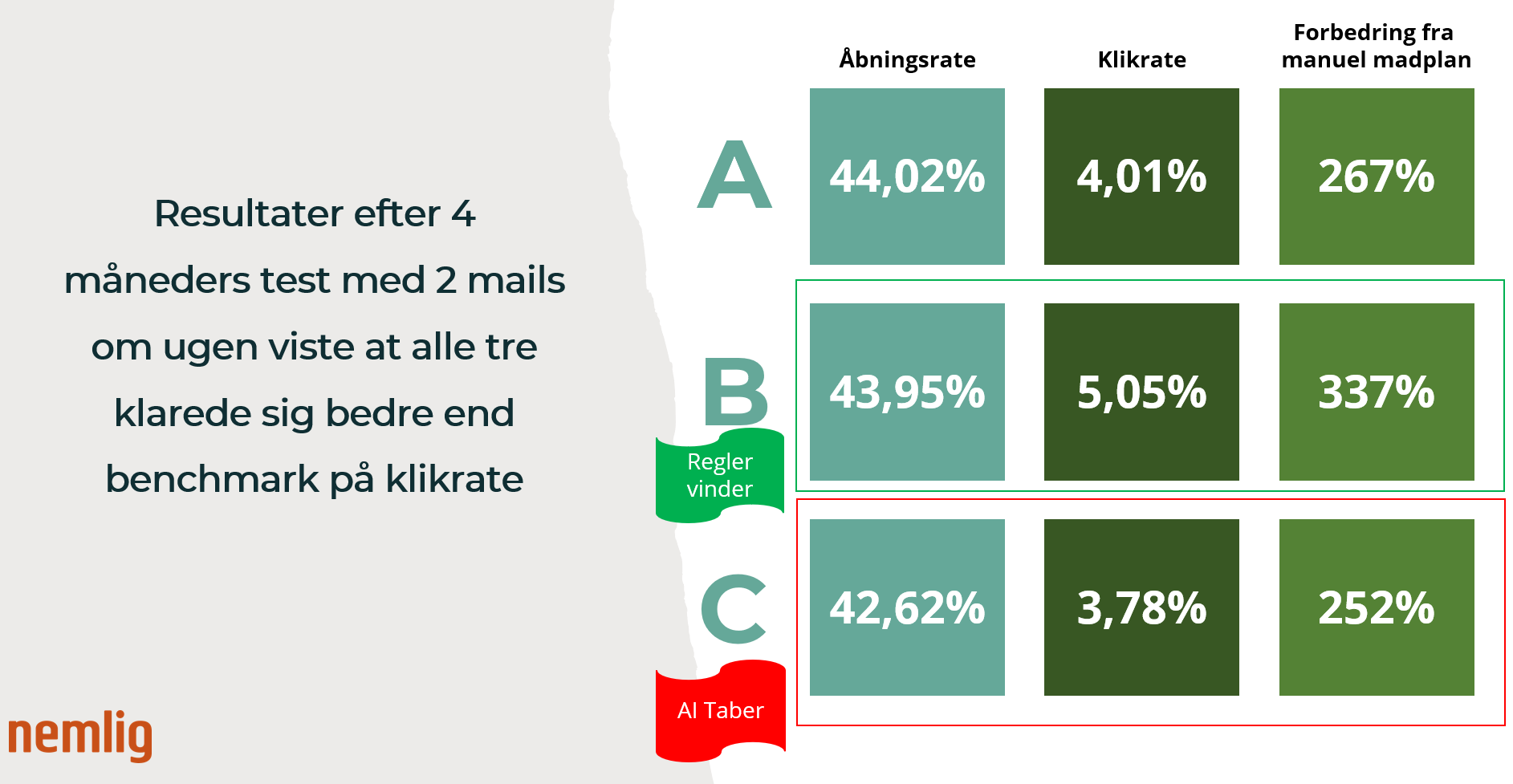
After 4 months of testing with two emails a week, the results were clear.
The best performing of the 3 email variants produced 337% more clicks from the email through to the recipe.
When that traffic also converts at over 5%, it is an improvement that shows directly in revenue and earnings.
The personal meal plan launched in January 2023 as an AI experiment.
Initially the experiment was about letting AI select dishes matching subscribers' preferences, and delivering 9–12 chosen dinner recipes to every subscriber twice a week.
The selection was made from Nemlig.com's database of around 3,000 recipes, and subscribers had 9 different preferences they could opt into and 6 they could opt out of.
After a few months it was clear that letting AI pick the recipes was not optimal:
Around 2–5% of the recipes the AI selected were not in the database.
Recipes were regularly chosen that did not match the preferences as well as they should.
One of the challenges was that a fair number of the recipes did not have enough metadata to indicate how well they matched the preferences.
A project was therefore started to enrich every recipe with relevant metadata against all the preferences. That work was carried out using AI, but with manual quality control.
After updating every recipe with relevant metadata, recipe selection was changed from AI-based to rule-based.
Alongside introducing rule-based recipe selection, 3 different variants were created of the email that presents the selected recipes to recipients:
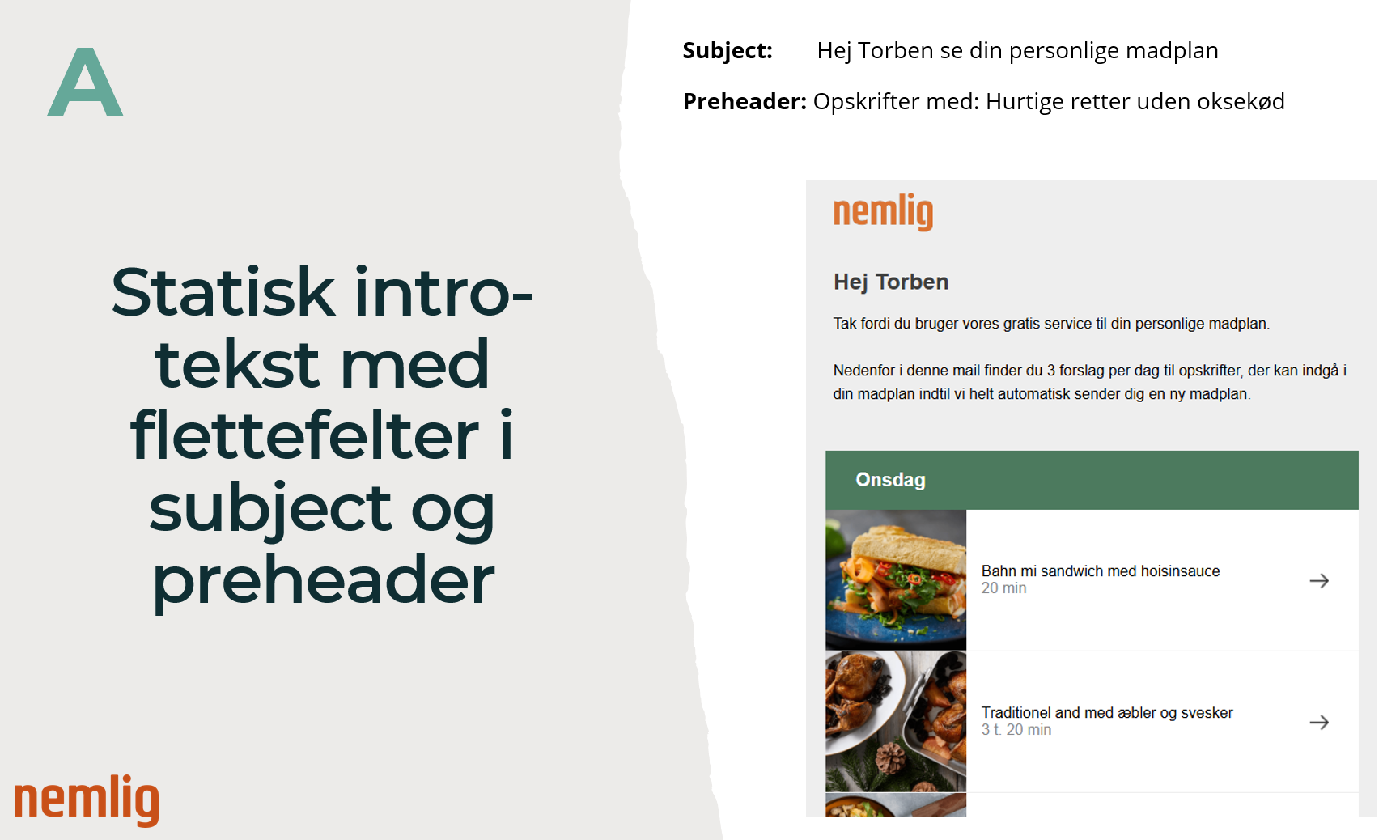
A. A static version, merging in up to 3 preferences in the preheader text only.
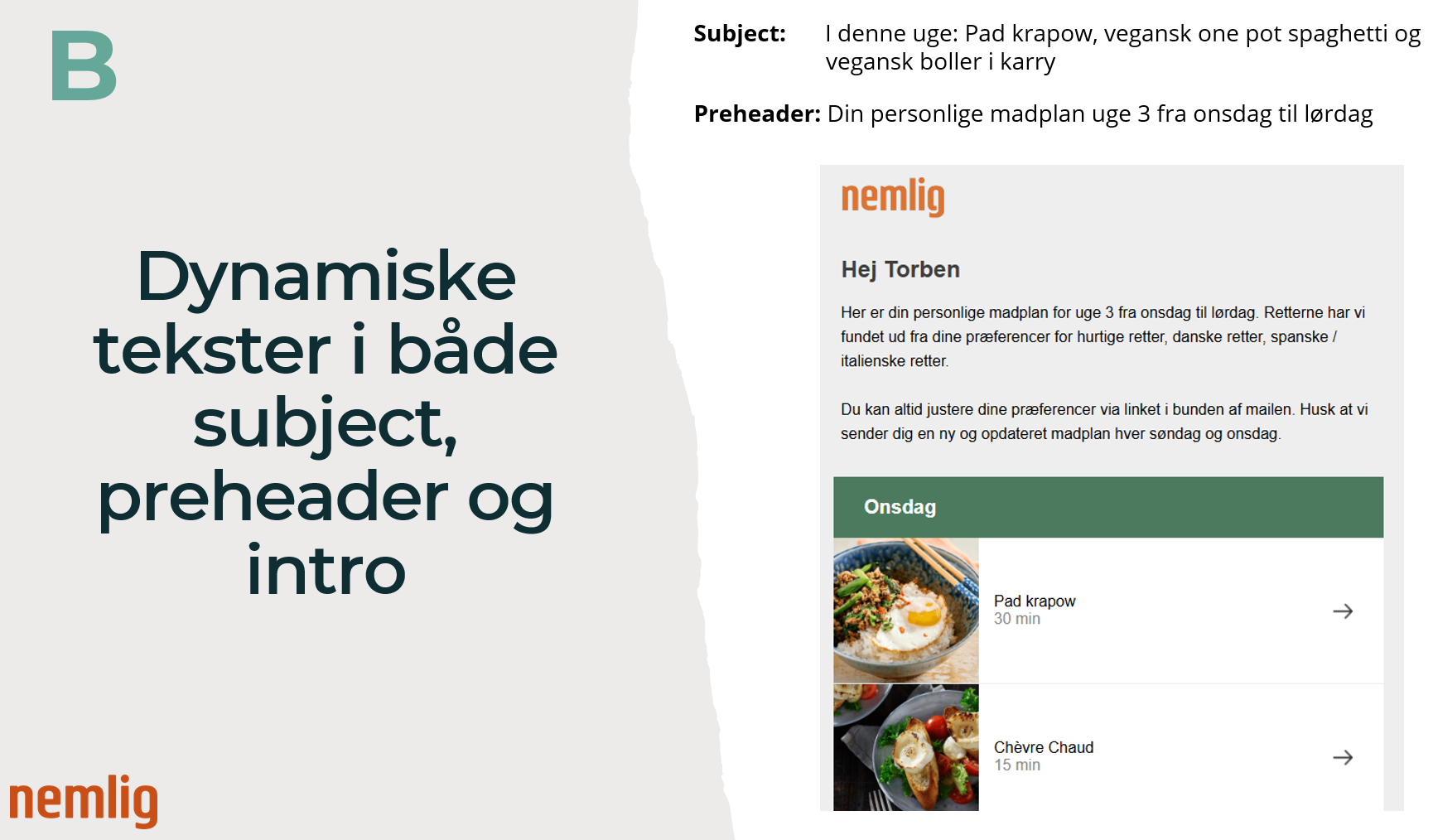
B. A dynamic version, with rule-based merging of 3 dishes into the subject line, plus merge fields with preferences in the intro text.
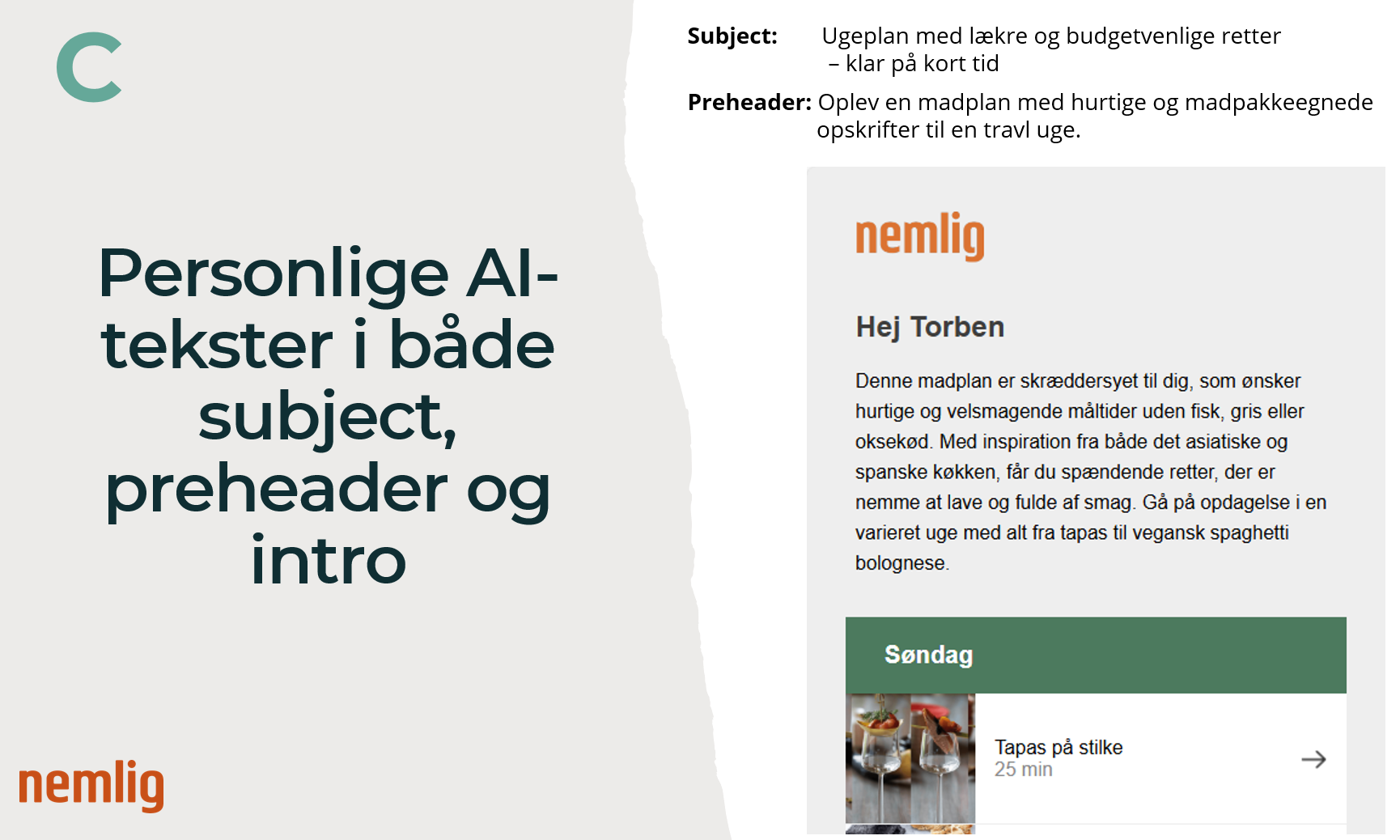
C. An AI version, where the subject line, preheader and intro text are all tailored individually based on preferences and the dishes in the email.
As the image above with the results shows, the AI version actually did slightly worse than the other two variants, while the best performer was variant B with the dynamic merge text.
It is worth bearing in mind that subscribers here receive the email twice a week, so they quickly know what it contains when it arrives.
It therefore cannot be concluded that AI-generated text gives worse results than text based on dynamic merge fields in every case.
But it can serve as a reminder that AI is not the only way to work with personalisation, and that in some cases alternative methods can produce better results.
Here is an example of variant A – static text:
Here is an example of variant B – dynamic merge text:
Here is an example of variant C – AI-generated text:
The whole solution is built in Yulsn Marketing Cloud, which also sends all the emails and has a direct integration to OpenAI.
The staff at Nemlig.com have access to edit the prompts and instructions themselves.
There is full access to check all the AI-generated text – and a large number of simulations were run before launch.
And there are built-in Power BI dashboards giving an overview of the results.
There is a data integration to the general set-up in Salesforce Marketing Cloud, but the decision was made to let Yulsn build the complete solution, as that was far more efficient than building it in Salesforce.