
Many companies primarily work with action-based loyalty. There are therefore good opportunities for differentiation.
28. juli 2025
Let me start by defining what I mean by behavioural and attitudinal loyalty:
Behavioural loyalty is when you use discounts, points or extra services as a reward for your customers' purchases from your company.
Attitudinal loyalty is when you give value to your customers without it being tied directly to their purchases. When you do that, you build an emotional preference for your company or your brand.
Over the past 25 years I have been involved in many company-specific analyses of customers' wishes and expectations of companies.
Some of the results that recur both in the various analyses I have been involved in myself and in the major study "Loyalitet i turbulente tider" from 2023, by Per Østergaard Jacobsen, Mogens Bjerre and Torsten Ringberg from CBS, are:
Most customers want and expect a reward for their purchases when they are part of a customer club.
Many customers are also interested in companies listening to them, inspiring them, involving them, and engaging with subjects the customers find important. In other words, giving value that is not tied directly to their purchases.
In a 2024 survey answered by 10,000 customer club members from two large Danish hotel chains, this was confirmed in two of the questions, on preferred sign-up benefits and preferred newsletter topics respectively.
The distribution of answers to two of the questions gives a good picture of discounts and offers being expected, but of there also being interest in inspiration and involvement:
1. Which sign-up benefits would you prioritise when joining a hotel chain's customer club?
42% chose: 20% off stays with a concert or other entertainment at the hotel, which non-members have to buy at full price.
36% chose: Entry into a monthly prize draw for a gift card worth 1,500 kroner.
33% chose: Welcome points equivalent to around 100 kroner off your next booking, or to spend in the restaurant on your next stay.
22% chose: A gift card worth 100 kroner towards your next booking or to give to someone else.
18% chose: Entry into a competition with prizes worth 100,000 kroner in total.
14% chose: An invitation to an exclusive members' event with snacks and a talk from an interesting speaker. Any overnight stay to be purchased separately.
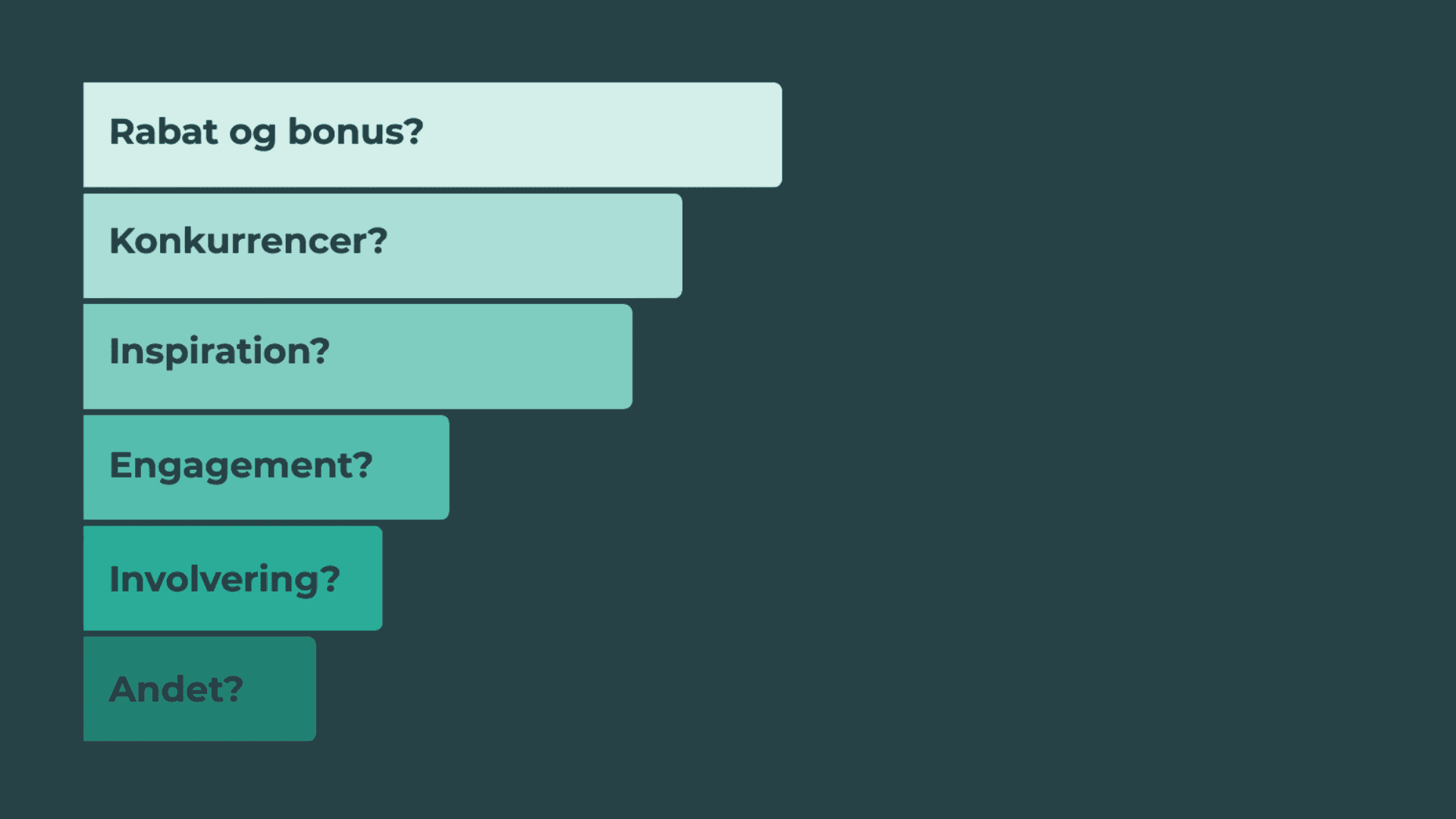
2. Which topics are most relevant for you to hear about in newsletters from your preferred hotel chain?
70% chose: Information about the week's good offers on stays and events.
48% chose: Inspiration for what to do near the hotel – attractions, walking routes, cycle routes, cultural experiences and so on.
37% chose: Information about events at the hotels and new hotels in the chain.
6% chose: Surveys that enable knowledge sharing between you as a consumer and the company, or involvement in developing new initiatives.
4% chose: Articles with inspiration from interesting people who have stayed at the hotel, or have some other connection to the area or the hotel.
2% chose: Other.
When you run surveys based on questionnaires sent to your own customers, there are a number of things to be very aware of – for example:
The distribution of answers depends a great deal on the options offered and how you ask.
It is very hard to know whether the answers you get are representative of the views of all your customers.
There can be large differences between what customers say they want and what their behaviour later shows.
There is a tendency for customers who are very satisfied and loyal to be over-represented among those who answer.
So is there any use for surveys like this at all?
I think there is. It can be an easy and very cheap way of testing the water, if for instance you have a number of different new initiatives and want feedback on which appear to hold the most interest.
Beyond that, this kind of thing helps show an interest in your members, and will typically get answers from 5–25% of them (depending entirely on how, and how much, the survey is exposed to members).
Finally, I would say the analysis results also fit well with my own practical experience from working with many different companies over the years.
So the short conclusion from me is:
Your customers would like you to inspire them and give value that is not tied directly to their purchases. You "just" have to work out how to do it so it makes sense for both the customers and your company.