
Mobile communication has for many years been dominated by one simple, direct and stable channel: SMS. But as our digital habits develop, new expectations arise for how companies communicate.

27. marts 2026
That raises a natural question: is SMS still enough as we know it, or can we use the channel differently to better meet our digital reality?
At Yulsn we find that more people are starting to ask exactly that. And this is where RCS can become relevant.
RCS stands for Rich Communication Services and is, in short, a further development of SMS. But where SMS is text-based, RCS opens up messages that are visual, interactive and more dialogue-driven.
An RCS message can, for example, contain:
images or video
clickable buttons
several options in a carousel
the ability to reply directly in the same flow
It all still takes place in the recipient's messaging app. So this is not yet another channel requiring a download – it is a development of a channel we already use.
Another significant innovation with RCS is that the sender MUST be validated by the telecoms operator in order to send RCS messages. That gives recipients far greater certainty about who the sender is than is the case with SMS.
It can be tempting to view RCS as "the new SMS". But in our experience it makes more sense to treat it as a supplement.
SMS still has strengths that are hard to replace: high delivery reliability, broad coverage and simplicity. RCS does something different. It creates the possibility of:
more context in the message
clearer visual communication
a more fluid dialogue
The question, as we see it, is therefore not necessarily whether RCS replaces SMS, but rather when it makes sense to use one over the other.
At Yulsn we are already working with RCS campaign setups.
A campaign might be a product launch where the recipient can act directly within the message. You could also use the format for service flows with appointment reminders that reduce friction and inefficiency. Or as part of your customer dialogue, where RCS works as a light chat interface in the messaging app. The possibilities are many.
Here are a couple of examples of the kinds of flow you can build:
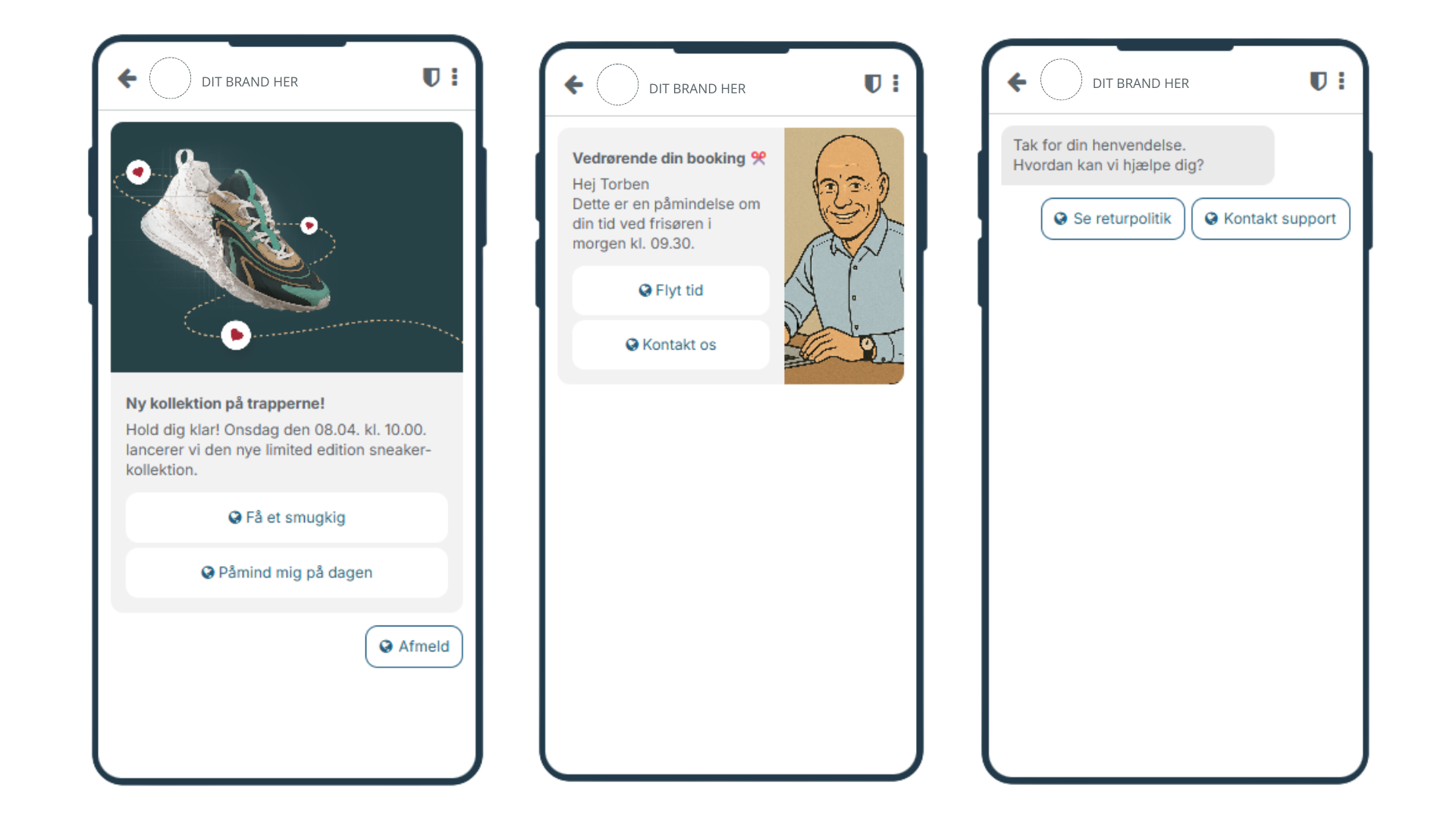
Something that quickly became clear to us in working with RCS is that the format makes the communication more prominent. That is without doubt an advantage, but it comes with demands.
With RCS, companies can certainly find it easier to create engagement. But our experience tells us the quality of their content becomes decisive – for whether the communication is experienced as value rather than noise. Because when it becomes easier to interact (by clicking, choosing and replying), it also becomes more obvious when the message is not relevant.
And relevance is the key to the relationship.
RCS is already widespread internationally, but in Denmark, at the time of writing, it is still only possible to send to Android devices on the operator 3.
For Yulsn that means we are currently working mainly with test setups, pilot campaigns and selected audiences – with SMS as a fallback, so the messages definitely arrive.
RCS probably will not arrive as a big switch from one day to the next. More likely as a gradual movement – towards more visual formats, dialogue and experience-driven communication.
It is a question both of when the technology is ready, and of when companies' communication is mature enough to ensure the consistent quality it demands.
So what does that mean for you?
It can make sense for some to start testing RCS now, particularly if you already
work actively with SMS
have your permissions in order
think in flows and customer journeys
If nothing else, it can start as a way of getting to know the format – and getting a better basis for judging whether RCS can add value to the relationship with your customers.
We are of course ready to help assess whether RCS makes sense in your setup; we can handle the campaign setup itself and connect RCS with your existing flows.
Curious about how RCS could be used concretely in your communication? Do say so – we would be more than happy to have a chat.